


In the competitive world of mattress manufacturing, where quality, durability, and ease of use are key factors, choosing the right components is of crucial importance. Among them, the zipper, seemingly a small element, plays a critical role in the functionality and aesthetics of a mattress. An incorrect choice of zipper length can lead to production problems, a decrease in product quality, and as a result, to end-consumer dissatisfaction.
Understanding the functional purpose of a zipper in a mattress
Before delving into technical details, it is important to clearly understand why a zipper is needed in a mattress at all. Its main functions include:
- Removable cover: A zipper allows the mattress cover to be easily removed for cleaning, replacement, or access to internal components. This is especially important for hygiene and extending the lifespan of the mattress.
- Assembly and disassembly: Some mattress models, especially complex or modular ones, may require zippers for assembly or disassembly, which facilitates transportation and storage.
- Firmness adjustment: In the premium market segment, there are mattresses with zones of variable firmness, where a zipper can be used to access layers that allow for adjusting the feel of the mattress.
- Aesthetics: A hidden or harmoniously integrated zipper improves the overall look of the mattress, giving it a finished and neat appearance.
- Production efficiency: A properly selected and easily installed zipper can significantly speed up the production process and reduce waste.

Determining mattress sizes and their influence on zipper length
Standardized mattress sizes are the starting point for determining the length. It is important to take into account both the nominal sizes and possible tolerances and design features.
Standard mattress sizes (approximate)
| Mattress type | Width (cm) | Length (cm) |
| Children’s | 60-80 | 120-160 |
| Single | 80-90 | 190-200 |
| Double | 120-140 | 190-200 |
| King | 160-180 | 190-200 |
| King Size | 180-200 | 200-220 |
| Super King | 200+ | 200+ |
Key aspects when choosing the length
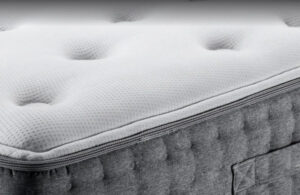
- Cover size, not mattress size. The zipper is sewn into the cover, not directly into the mattress. Therefore, the dimensions of the cover, which may differ slightly from the nominal dimensions of the mattress (for example, due to technological seam allowances, fabric thickness, lining), are the determining factor.
- Type (open-end/closed-end):
- Open-end: have two separate parts that completely detach. They are ideal for covers that need to be completely removed. The length of such a zipper should correspond to one of the sides of the mattress cover, or be slightly shorter for ease of installation.
- Closed-end: have a “closed” loop. They are used for covers that do not require full separation, for example, if you only need to partially open the cover to access the internal components. The length of such a zipper will be equal to the perimeter of the mattress sides minus the necessary technological clearance for convenient installation.
- Location:
- On one side: the most common option. The length of the zipper will correspond to the length or width of the mattress.
- On three sides: used for covers that are completely removed from the top of the mattress. In this case, the length is calculated as the sum of three sides (for example, width + length + width).
- Around the perimeter (circular or “L”-shaped): is found less frequently, but provides full access to the mattress. The length will correspond to the perimeter of the mattress (2 * (length + width)).
- Technological allowances. Always add a small allowance (1-3 cm) to the calculated length. This will avoid fabric tension, facilitate sewing in, and ensure the smooth operation of the zipper. It is better to have a small reserve than insufficient length.
- Technological clearance for ease of connection (for non-separable zippers). If the zipper runs around the perimeter, it is necessary to provide a small unstitched “tail” at the beginning and end of the product to ensure easy connection and prevent fabric from shifting during zipping up.
Formulas for calculating zipper length
The formulas below are basic. Always adapt them to your specific production processes, tolerances, and mattress design.
| Description | Calculation |
| Formula for an open-end zipper | Zipper length = Mattress (or cover) width + Allowance (1–3 cm). |
| Formula for a closed-end zipper | Zipper length = 2 * (Mattress (or cover) length + Mattress (or cover) width) – Necessary clearance (e.g., 10-20 cm for ease of installation) + Allowance (1-3 cm). |
| Formula for a three sides zipper | Zipper length = Mattress (or cover) length + 2 * Mattress (or cover) width + Allowance (1-3 cm). |
Calculation examples:
- Single mattress (90×200 cm) with a separable zipper on the long side
- Zipper length = 200 cm + 2 cm (allowance) = 202 cm.
- Double mattress (160×200 cm) with a “P”-shaped zipper
- Zipper length = 200 cm (length) + 2 * 160 cm (width) + 3 cm (allowance) = 200 + 320 + 3 = 523 cm.
- King Size mattress (180×200 cm) with a non-separable zipper around the perimeter for a two-component design (for example, for a removable top layer):
- Zipper length = 2 * (180 cm + 200 cm) – 15 cm (clearance) + 2 cm (allowance) = 2 * 380 – 15 + 2 = 747 cm.

Important aspects to consider when choosing a zipper
In addition to length, there are other key parameters that should be carefully considered:
- Zipper type. For mattresses, zippers T4, T6, T6 reversed, P5, P7 are usually used, as they provide sufficient strength and durability.
- Material and tape: spiral zippers with polyester tape are the most common. It is important to make sure that the materials are resistant to wear, do not fade and do not deform over time.
- Slider quality: sliders must be strong, slide easily, and not jam. The size of the lock handle also matters, less massive and miniature ones are more comfortable during use.
- Color: the choice of color must match the design of the mattress. Zipper suppliers offer a wide range of colors to fit harmoniously into the product’s aesthetics.
- MOQ (minimum order quantity): when ordering zippers in large quantities, pay attention to the supplier’s MOQ. This can affect your production costs and logistics.
- Delivery times: timely planning and established delivery logistics are key to the uninterrupted operation of production. Evaluate the delivery times from different suppliers.
- Certification: it is important that the materials used in zippers comply with safety standards, especially if the mattress is intended for children. The presence of certificates such as Oeko-Tex Standard 100 is an advantage.
Conclusion
Choosing the correct zipper length for mattresses of different sizes is not just a technical task, but a strategic decision that affects product quality, production efficiency, and customer satisfaction. A careful analysis of the mattress dimensions, zipper type, its location, and technological allowances is the basis for successful production. Taking into account all aspects, from materials to quality control and interaction with suppliers, mattress manufacturers can ensure that their products will be not only comfortable and durable but also meet the highest quality standards, which will ultimately strengthen their position in the market. Investing in the right zipper choice is an investment in the reputation and competitiveness of your business.
