


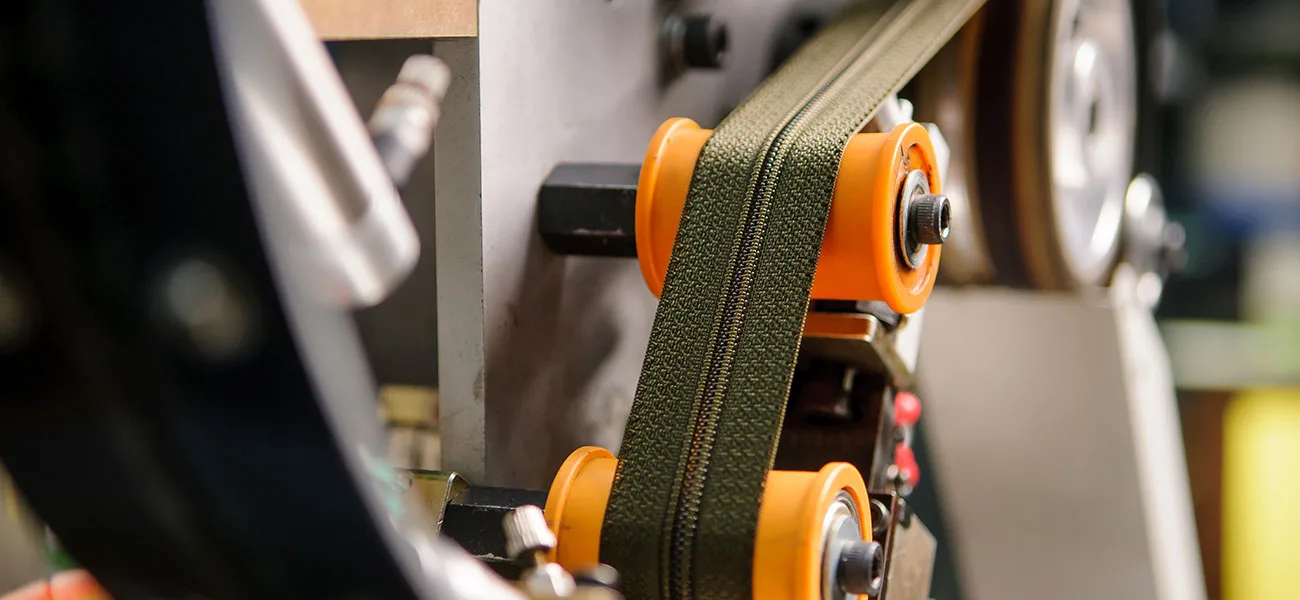
Zippers play a crucial role in the production of clothing, footwear, and accessories. Their reliability defines the overall quality of the final product. That’s why Molniya places special emphasis on thorough zipper strength testing and zipper durability testing. These procedures are carried out in the company’s own accredited laboratory, equipped with high-precision German and Japanese machines. They allow for physical and mechanical testing at every stage of manufacturing — from raw material inspection to final product quality control.
Testing a woven zipper for chain strength
One of the key procedures in testing zippers for strength is the assessment of the breaking force of closed zipper elements. This test simulates real-life usage conditions and evaluates how well the chain links hold under high tension. The zipper is mounted in a testing machine that gradually increases the load until the chain breaks. The results determine whether the zipper meets local (DSTU) and international standards of strength and whether it can withstand the loads expected during actual use.
Zipper durability testing: opening and closing cycles
To ensure long-lasting quality, zippers undergo wear tests involving repeated opening and closing. This zipper durability testing is conducted on special rigs that automatically open and close the zipper thousands of times, simulating intensive daily use.
At Molniya, the standard test cycle ranges from 500 to over 1,500 operations, depending on the type of product. If the zipper teeth remain firmly locked and the slider functions smoothly after testing, the zipper is deemed suitable for use in clothing and accessories manufacturing.
Additional testing is carried out on zipper sliders. Molniya thoroughly tests the strength and durability of sliders in its own laboratory. These tests are essential to ensure the long-term functionality of the accessory, especially under frequent use.
Water-repellent zipper testing
Zippers used in the production of waterproof clothing and gear undergo strict testing for water resistance. Molniya uses multiple procedures to evaluate the properties of water-resistant zippers:
- Spray test — the zipper is exposed to fine water mist, and its ability to repel moisture is assessed.
- Water column resistance test — the zipper’s seal is tested under water column pressure in a certified lab.
- Gore-Tex test — the zipper is submerged 1 cm in water for two hours. If water rises less than 10 mm along its structure, the zipper passes.
These tests ensure the quality and reliability in extreme conditions.
OEKO-TEX Certification
Another essential part of zipper testing is compliance with international eco-friendliness and safety standards like OEKO-TEX. Molniya submits its finished zippers to certified laboratories for evaluation. The OEKO-TEX test ensures that zippers are free from harmful substances and meet high ecological safety standards. The manufacturer renews this certification annually to confirm its product quality.
Conclusion
Molniya places a high priority on the testing of its zippers for strength, durability, and water resistance. These comprehensive procedures allow consumers to trust the reliability of the products, which meet the highest standards of safety and performance. Quality control and ongoing technological improvement enable Molniya to remain a leader in zipper production across various industries.
