


In the manufacturing of military clothing and military gear, where reliability is not just an advantage but a matter of survival, the choice of components becomes critically important. Zippers — seemingly a minor detail — play a crucial role in the functionality and safety of soldiers. They ensure quick access, weather protection, and the ability to respond swiftly in extreme conditions.
This article is aimed at industrial customers — manufacturers of military apparel, tactical gear, and military equipment — and highlights the specific requirements for zippers used in this highly specialized and demanding sector.

More than just a fastener: why zippers for military clothing require a special approach
Unlike in civilian apparel, where a zipper may serve purely as an aesthetic or convenient feature, in the army sector, it faces unparalleled challenges:
- Extreme operating conditions. From cold to desert heat, from heavy rain to exposure to aggressive chemicals, zippers must remain functional in all weather conditions.
- Mechanical loads. Continuous movement, friction, stretching, impacts, and the need for rapid opening/closing under stress demand exceptional strength.
- Camouflage and compatibility. Zippers must not reveal a soldier’s position through glare or noise. They also need to be compatible with other gear and equipment.
- Durability and field repairability. Military gear must last a long time and be repairable under field conditions.
- Specific safety requirements. Some types of military zippers must be flame-resistant or chemically resistant, depending on the intended use.
Key requirements for zippers for military gear and clothing
When selecting zippers for military applications, manufacturers must consider the following parameters:
1. Materials
- Strength and corrosion resistance. Preference is given to stainless steel, high-grade alloys, brass, or specialized polymers that resist rust and mechanical damage.
- Temperature resistance. Materials must retain their properties in both low and high temperatures without deformation or loss of strength.
- UV resistance. Prolonged sun exposure must not degrade the material.
- Chemical resistance. In specialized military apparel, zippers must resist fuels, lubricants, solvents, and disinfectants.
2. Type and construction
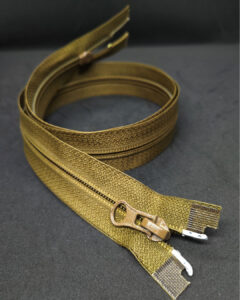
- Molded plastic zippers (tractor zippers). Frequently used due to their high durability and dirt resistance.
- Spiral zippers (coil zippers). Used where flexibility and compactness are needed, but with reinforced strength.
- Waterproof zippers (water-resistant zippers or water-repellen). Essential for outerwear, backpacks, and gear requiring moisture protection.
- Two-way zippers. Allow opening/closing from both ends — critical for operational tasks.
- Auto-lock sliders. Prevent accidental opening during movement or under load.
3. Ergonomics and usability
- Large, easy-grip pullers. Must allow operation even while wearing gloves.
- Low-profile design. Zippers should not protrude or snag on other objects.
- Noise reduction. Metal zippers can be noisy; military designs often have coatings to minimize sound.
4. Standards and certification
- Zipper manufacturers for military gear must comply with international standards like ISO, as well as national and defense-specific requirements (e.g., MIL-SPEC in the US or NATO/EU military standards). In Ukraine, zipper production for military use follows the Ministry of Defense regulations, which define requirements for materials, strength, wear resistance, and other performance criteria.
- Certification proving compliance — including tests for strength, extreme condition resistance, and water resistance — is mandatory.

Conclusion
Choosing zippers for military apparel and military equipment is a critical process requiring deep knowledge of specialized standards. Working with reliable suppliers ensures the creation of durable, functional, and safe military gear.
In situations where lives are at stake, compromises on quality and reliability are unacceptable. Investing in zippers that meet the highest standards is an investment in the safety and effectiveness of soldiers.
